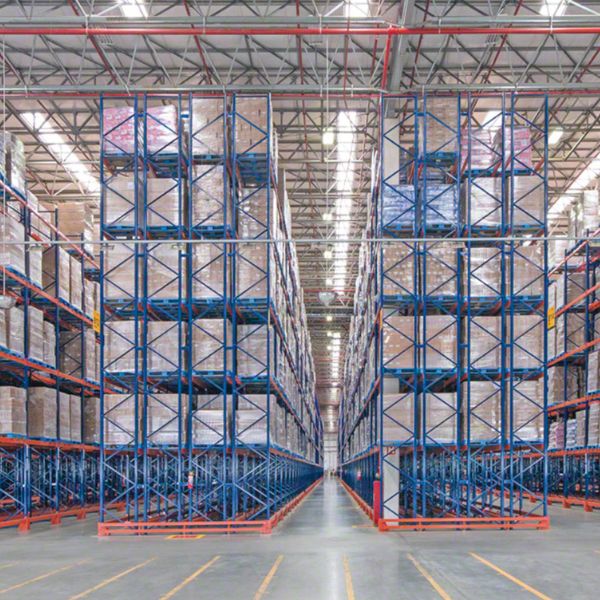
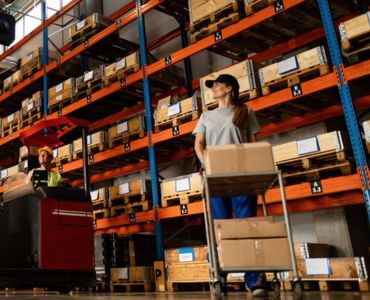
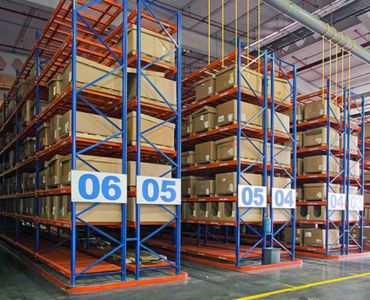
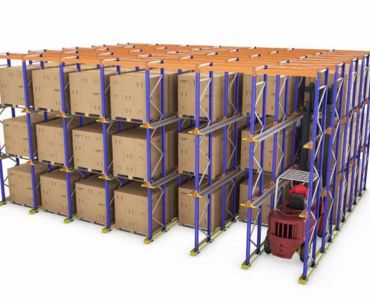
The Double Deep Pallet Racking System is a savvy storage solution that permits storage of two pallets deep within the same bay, with aisles separating the two rows. It’s popularly known as the 2-deep pallet racking system as well. The principal merit of this system lies in its space-saving feature. It allows more pallets to be stored in a smaller area, when contrasted with single deep pallet racking. Utilizing this system can escalate the storage capacity of a warehouse by up to 50%. It varies based on the warehouse’s size and the type of pallets stored. The Double Deep Pallet Racking System works well for warehouses needing higher storage density, while also maintaining selectivity. However, it necessitates unique equipment for access to the rear pallets, such as a reach truck equipped with a pantograph mechanism or a specialized double-deep forklift.
Configuration: The design of double deep racking is akin to selective racking, but distinguishes itself by accommodating pallets two deep instead of the conventional one. This allows for enhanced storage density within the same space, a marked improvement over selective racking.
Access and Selectivity: A downside to double deep racking is the compromised accessibility and selectivity it comes with, for increased storage density. To retrieve pallets stacked at the rear requires the removal of the pallets at the front.
Forklift Requirements: The use of double deep racking necessitates specialized forklifts equipped with extended reach or telescopic forks for reaching into rear pallet positions. It is crucial to maneuver these forklifts skillfully to place and retrieve pallets.
Storage Density: The predominant advantage of double deep racking lies in its superior storage density when contrasted with selective racking. It ensures optimal utilization of available space, making it ideal for storing larger quantities of the same kind of product.
Suitability for Same SKU Pallets: Double deep racking is most beneficial for storing various pallets of identical SKUs. It might not be as appropriate for storing a diverse range of products that necessitates frequent access.
Design Planning: The planning of a double deep racking system involves careful calculation of aisle widths, forklift capabilities, and product turnover speeds. It's critical to balance the need for maximized storage space with the efficiency of pallet retrieval.
Pallet Placement and Removal: During the process of loading or unloading pallets, the handlers must cautiously position or retrieve the front pallet prior to accessing the rear one. This may result in a slight delay in retrieval times in comparison to selective racking.
Benefits: Double deep racking provides greater storage density making it a more space-efficient choice in contrast to selective racking. This can potentially be a robust solution for businesses with a high volume of identical SKUs.
Drawbacks: The drawbacks of double deep racking include limited selectivity and difficult access to the rear pallets. Specialized forklifts may also be required. Additionally, there might be diminished visibility of the rear pallets which could necessitate additional lighting.
Use Cases: Double deep racking is typically utilized in warehouses and distribution centers where maximizing storage density is a priority and where goods are stocked in larger volumes but with lesser variations.
It is crucial to assess your storage needs, the rate of product turnover, and the available space before opting for double deep racking. Consultation with storage system experts could assist in determining if double deep racking would be the most suitable arrangement for your specific requirements.