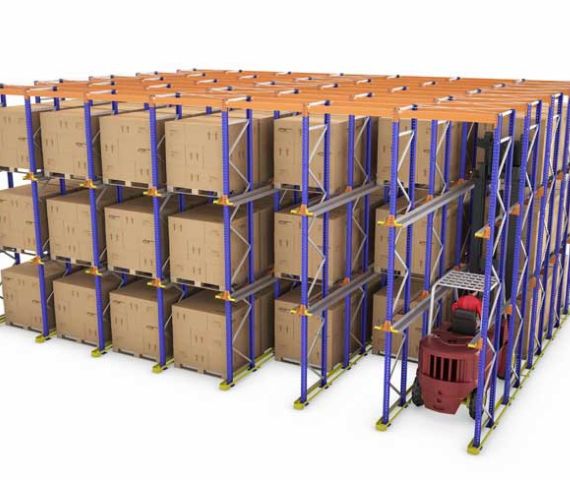
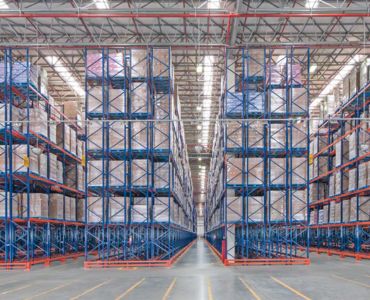
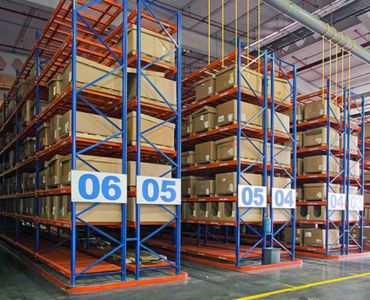
Drive-through racking system, also known as drive-through pallet racking, is a high-density storage system allowing forklifts to access pallets from both sides. It consists of rails or tracks for the forklifts to drive directly through for loading and unloading. It operates on a first-in, first-out (FIFO) basis, making it suitable for warehouses storing large quantities of the same product needing high accessibility. It is widely used in sectors like food and beverage, retail, and distribution.
Design: Like drive-in racks, drive-through racks also allow forklift access but offer an added advantage - they can be accessed from both sides. They are designed with entrance points on one end and departure points on the opposite end, enabling a forklift to drive straight through the entire structure.
FIFO or LIFO Operation: These racking systems are flexible and can accommodate either a First-In, First-Out (FIFO) or Last-In, First-Out (LIFO) inventory management policy, based on the specific operational requirements of the warehouse.
Accessibility and Selectivity: Drive-through racks offer greater selectivity over drive-in racks, as they allow access to pallets from both ends. This dual access advantage is particularly beneficial where balanced stock rotation is required.
Important Factors: Sufficient room for forklift operations upon both entrance and departure points is crucial. Thoughtful organization of in-warehouse traffic is necessary to prevent overcrowding and maintain safety.
Drive-in/drive-through Racking Systems
The Drive-in/Drive-thru Pallet Racking denotes a storage technique where pallets or skids are accommodated on steel rails with the assistance of forklift trucks. The forklift trucks, guided by floor rails, serve the purpose of placing and retrieving pallets within the system.
Drive-in Racking System
Drive-in racking is a high-density storage system that optimizes warehouse space use by decreasing aisle space and increasing pallet positions. This system, often used in the food and beverage, manufacturing, and pharmaceutical sectors, is composed of rails or tracks that support pallets and enable forklifts to load and unload them directly. Ideal for storing large quantities of identical products, this racking system works on a first-in, last-out (FILO) basis. It’s also beneficial in freezer and cooler storage applications where effective space use is crucial.
Works through principle of First-In Last-Out (FILO): The system functions primarily on the FILO principle.
Can Accommodate a Significant Volume of Identical Products: It has the capacity to store extensive amounts of homogeneous products.
Provides Excellent Product Safeguarding: The system ensures a high level of protection for the stored products.
Drive-in racking provides a high storage density by removing the need for individual aisles. This method however reduces selectivity as the forklift has to take out the front pallets to reach those stored behind.
Potential 30% Pallet Redundancy: If the warehouse is used for storing a broad variety of products, the redundancy of pallets could increase up to 30%.
Drive-in racking provides high storage density as it eliminates the need for individual aisles. However, this results in a reduction of selectivity as the forklift must remove the front pallets to access those stored behind.
Drive-in and drive-through racking systems are used in industries that require high-density storage like cold storage, beverage distribution, and manufacturing. They are beneficial for storing long shelf-life products or in scenarios with less frequent product movement. It’s crucial to evaluate your storage requirements, product features, and operational needs when considering these systems to find the most appropriate solution for your warehouse or distribution center.