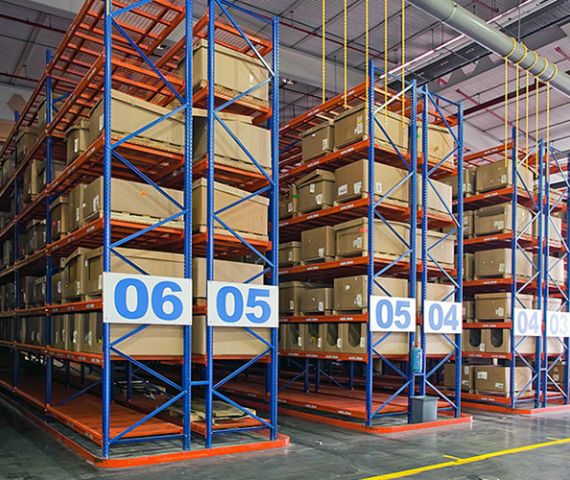
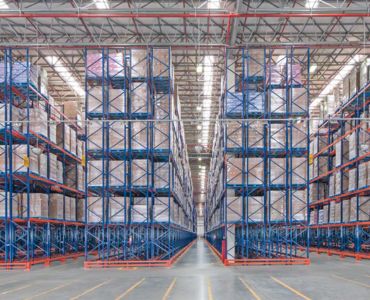
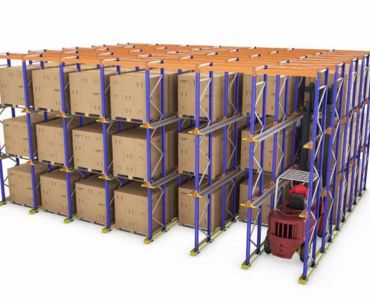
The VNA (Very Narrow Aisle) racking system is a high-density storage solution designed to optimize the utilization of available warehouse space. With its design being specific for narrower aisles, this racking system decreases aisle widths and enables an increased number of pallet positions. It’s specifically designed for compatibility with specialized VNA forklifts, which are adept at operating within these confined spaces. The space utilization rate for a VNA racking system tends to surpass that of standard selective pallet racking or double deep pallet racking systems. This is due to the VNA system’s ability to accommodate a larger number of pallet positions per square meter. However, factors such as the racking height, aisle width, and forklift size can cause variations in this percentage. Generally, VNA racking systems are an excellent choice for warehouses with high-density storage needs and restricted floor space.
Characteristics of VNA Racking: The principal characteristic of Very Narrow Aisle (VNA) racking is the use of substantially narrow aisles typically measuring between 1.6 and 2.0 meters, or roughly 5 to 6.5 feet. This is a stark contrast to the wider aisles necessitated by conventional forklifts in selective racking systems.
Requirement for Specific Forklifts: To operate within a VNA racking system, specialized narrow aisle forklifts are required. These may also be referred to as turret trucks or man-up trucks, and are particularly crafted to operate within confined spaces and lift pallets to considerable heights. These forklifts are equipped with articulating forks that have the capability to rotate and extend to reach pallets stored within the racking system.
High Storage Density: One of the biggest advantages of VNA racking systems is their exceptional storage density. Through optimal utilization of vertical space within the warehouse, these systems are able to store pallets at significantly higher heights as compared to traditional racking systems. This superior storage density makes them an ideal choice for warehouses constrained by limited floor space.
Selectivity Issues: VNA racking systems offer impressive storage density. However, there's a potential trade-off in selectivity as accessing individual pallets might take a bit longer due to requirements for specialized forklifts as well as meticulous maneuvering within the compact aisles.
Guidance System: In the interests of precise and safe operation within the slim aisles, VNA forklifts typically resort to floor-embedded wire or rail guidance systems. These systems facilitate the forklift in adhering to a pre-determined path.
Warehouse Layout Planning: Efficient implementation of VNA racking systems necessitates meticulous planning of the warehouse layout. This is significant to streamline the flow of forklifts, avert congestion, and maximize total storage utility.
Pros: VNA (Very Narrow Aisle) racking systems are perfect for storage facilities that wish to utilize their space optimally and deal with a minimal assortment of SKUs. This system considerably expands the number of accessible pallet spots within the existing warehouse space.
Factors to consider: Setting up a VNA racking system implies investing in specialized forklifts, guidance systems, and potentially modifying the warehouse structure. Well-planned training programs and safety measures are of utmost necessity due to closely spaced operating conditions.
VNA racking is ideal for organizations that need enhanced storage density and manage high quantities of consistent products. However, they might not be ideal for situations that require frequent access to individual pallets or rapid picking of a diverse range of products. As with any racking system, collaborating with warehouse design experts and storage solution professionals is vital to decide whether a VNA racking system aligns with your specific needs.